




Author:Wall Street CN
US President Donald Trump is preparing to launch a $12 billion strategic critical mineral reserves program aimed at protecting US manufacturers from supply chain disruptions and further strengthening national industrial security by establishing a commercial stockpile mechanism.
According to media reports, this project, known as "Project Vault," will utilize a $10 billion loan from the Export-Import Bank of the United States, combined with $1.67 billion in private capital, to procure and store minerals for automakers, technology companies, and other manufacturing giants.This will be the first such reserve project in the U.S. private sector, not only in terms of size but also in its operational model, which is similar to the nation's strategic petroleum reserve.
The plan has attracted participation from more than a dozen industry giants, including General Motors, Alphabet's Google, and Boeing. Trump is scheduled to meet with GM CEO Mary Barra and mining billionaire Robert Friedland on Monday, while the board of directors of the Export-Import Bank of the United States will vote on the same day to approve the record 15-year loan authorization.
As a result of this news, the market expects the plan to provide a buffer against price fluctuations in related commodities and directly benefit the US domestic mineral supply chain.
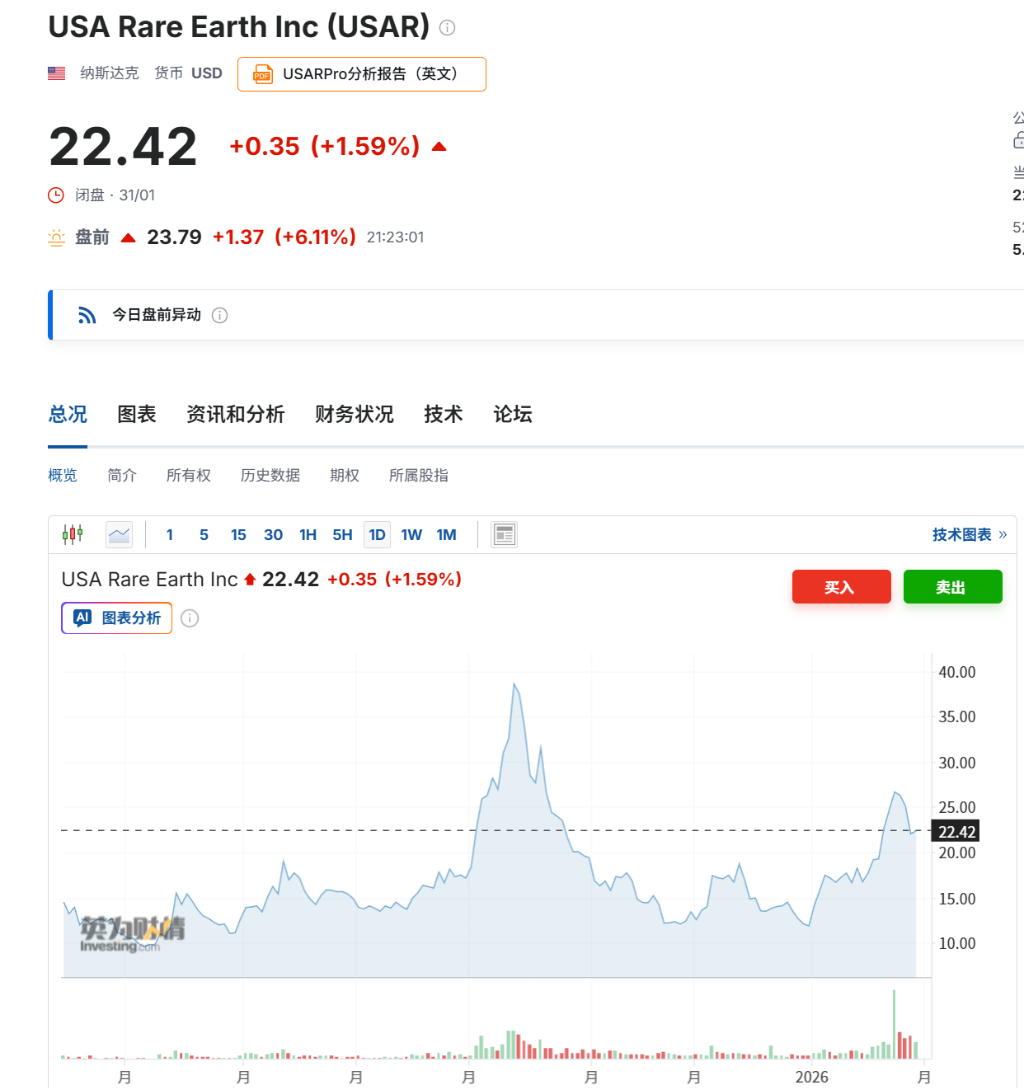
U.S. rare earth stocks rose in pre-market trading on Monday. Gainers included: U.S. Rare Earth (up 6.11%), U.S. Antimony (up 5.3%), Critical Metals (up 8.4%), MP Materials (up 4.6%), Ramaco Resources (up 3.7%), NioCorp (up 4.6%), and Trilogy Metals (up 0.8%).
Pioneering Private Sector Reserve Mechanism
Project Vault's core structure combines public credit with private investment. The $10 billion loan planned by the Export-Import Bank of the United States is more than double the size of the bank's second-largest deal in history. In addition to public funds, the project has also brought in $1.67 billion in private capital. According to senior government officials, the project was oversubscribed during its financing phase because investors valued the creditworthiness of participating manufacturers, their long-term commitments, and the support of the U.S. Export Credit Agency.
Although the specific list of institutional investors has not yet been made public, this financing structure establishes the first U.S. mineral reserve specifically for private sector needs.Previously, although the United States possessed national critical mineral reserves serving its defense industrial base, it lacked corresponding mechanisms for civilian needs.
Operational Model and Inventory Management
The reserve will focus on key minerals such as gallium and cobalt, used in iPhones, batteries, and jet engines, and will also cover rare earths and other strategic elements with volatile prices. Three major commodity traders—Hartree Partners LP, Traxys North America LLC, and Mercuria Energy Group—have signed an agreement to act as procurement specialists responsible for purchasing raw materials.
In practice, participating manufacturers pay upfront fees and bear holding costs related to loan interest and inventory. Companies can submit a list of their preferred materials to Project Vault. In the event of supply disruptions, companies can fully deplete their inventory, but must replenish it subsequently. Furthermore,The mechanism is designed with a stabilizer: manufacturers who commit to purchasing a certain quantity of materials at a specific price must also commit to repurchasing the same quantity at the same cost in the future, thereby smoothing out market fluctuations.
Hedging supply chain risks and geopolitical competition
Project Vault aims to help companies such as Stellantis NV, Corning Inc., and GE Vernova Inc. mitigate the impact of volatile raw material prices on their balance sheets. Previously, the surge in nickel prices following the outbreak of the Russia-Ukraine conflict highlighted the risks of supply chain fragility.
This plan is also part of the Trump administration's efforts to directly invest in domestic mining companies and enhance domestic rare earth production and processing capabilities.Meanwhile, the U.S. government has signed cooperation agreements with countries such as Australia, Japan, and Malaysia, and plans to push for more such conventions at a multinational summit in Washington on Wednesday.