


Author:99Bitcoins
After the events of this week, it is safe to say DeFi will never be the same again. Yes, there are over $132Bn managed by different protocols, and Aave is the largest of them all. For years, the team has built a reputation for being conservative, and the results are evident for everyone to see.
Presently, Aave manages over $32.2Bn worth of assets across 18 chains at press time. However, a big chunk of this is in Ethereum. That Aave controls more assets than Lido, a liquidity staking platform primarily helping secure Ethereum, is a massive vote of confidence for decentralized money markets.
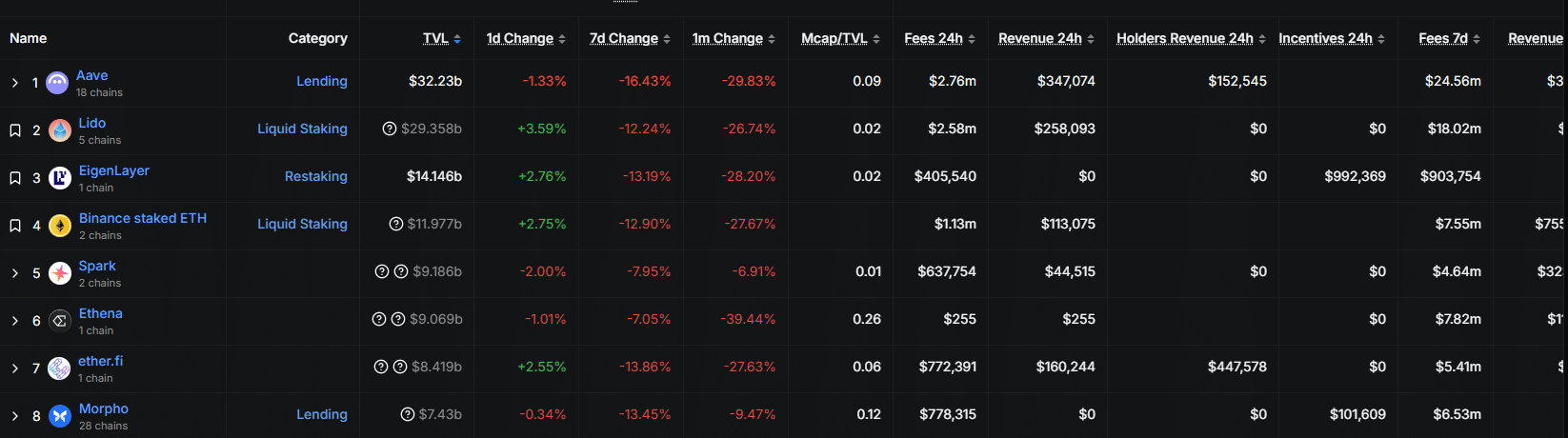
(Source: DefiLlama)
Reflecting this impressive growth is the rapid expansion of AAVE crypto prices in 2025. Perched among the top 50 most valuable coins, AAVE crypto is more valuable than BGB, the token behind Bitget. What’s more? AAVE is worth more than PYUSD, the stablecoin associated with PayPal, the payment processor.
Aave Is Shining Bright, But There is a Problem
Even with the billions under management in Aave and the protocol’s resilience amid the “destructive” volatility of this week, and especially of October 10, questions are being asked about the preferential treatment it has with USDe and sUSDe.
You see, earlier this year, there was a proposal (which was approved) to “hardcode” the floating price of sUSDe and USDe, the algorithmic stablecoins issued by Ethena Labs, with USDT.
Despite the absence of an official audit of Tether’s reserves, USDT has maintained its peg in recent memory.
Unfortunately for crypto, if USDT falls, billions will likely be liquidated, mostly on decentralized money markets like Aave.
Still, this hardcoding helped save thousands of USDe holders on Aave when crypto prices crashed on October 10. While perpetual exchanges raked in billions in profits from liquidations, there was something else that happened.
USDe depegged on Binance, falling to as low as $0.65 due to redemption pressure, and notably, due to failed delta-neutral strategies. Interestingly, on multiple other platforms, including Curve, Coinbase, and Uniswap, USDe stayed relatively stable at around the ideal $1 mark.
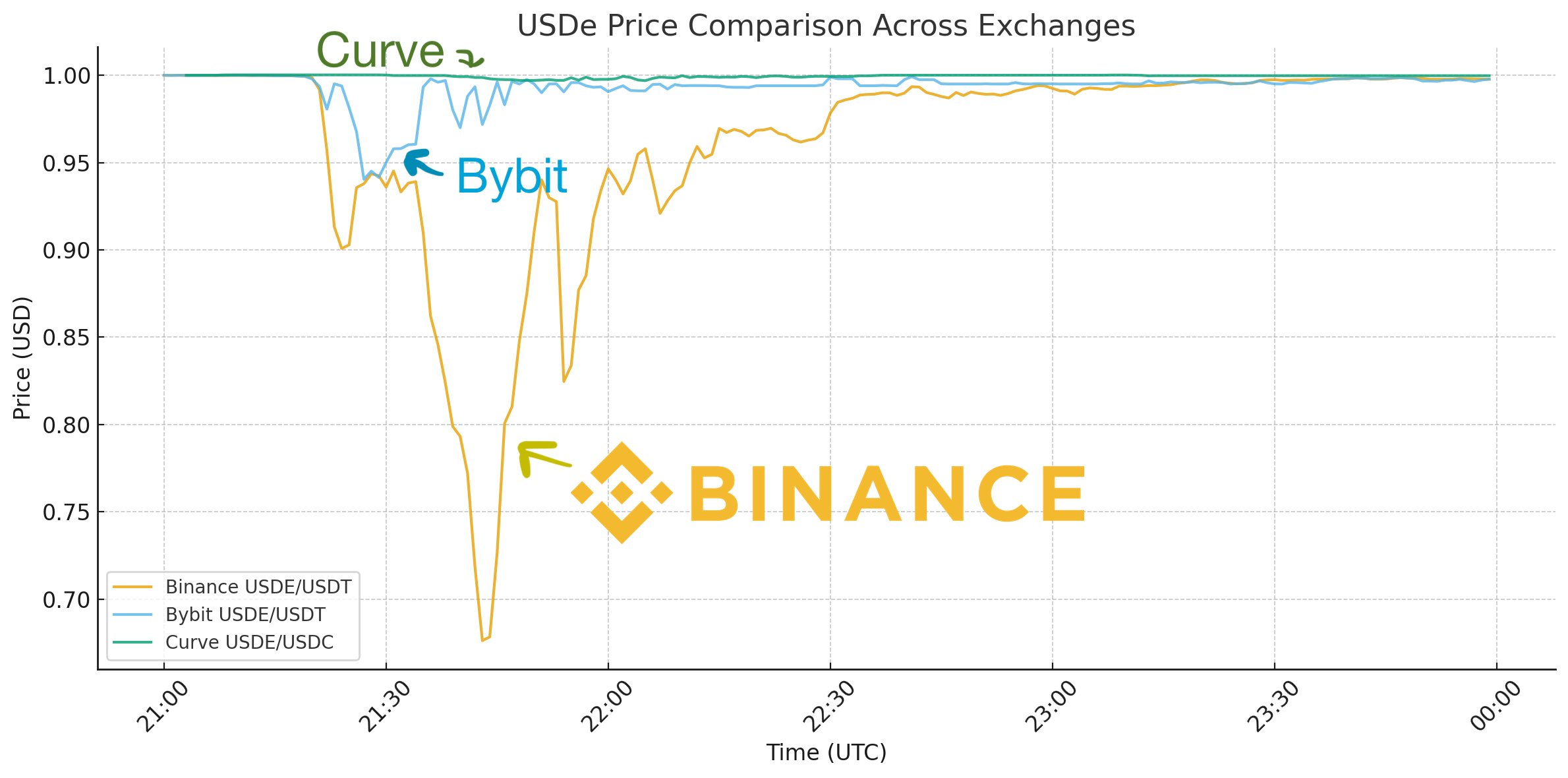
(Source: Hosseeb, X)
DeFi Blue Or Red Pill Moment
Although the hardcoding of USDe with USDT helped save hundreds of millions of collateral from being liquidated, there are still risks.
It all stems from the recent chaos following the chaos at Stream Finance and the depegging of xUSD.
In his view, should there be a major depegging event, these entities should be guilty and “complicit in the loss of user funds.”
Lessons can be learned from Morpho, Euler, and Elixir, as well as other protocols which hardcoded the stablecoin oracles of xUSD to $1 to smooth volatility and prevent mass liquidation.
Although their TVL soared, the unfortunate thing is that it creates an illusion of stability, which is attractive to users in search of predictable yields.
For a moment, the Aave USDe hardcode saved millions from liquidation, but it masks risks. When xUSD, which was used as collateral in protocols such as Morpho and Euler, collapsed, these protocols were left holding the bag. What’s more, lenders are stuck and can’t withdraw funds.

https://twitter.com/robdogeth/status/1985768395631955969
While not ideal, protocols should, in the view of the critic, accept real-time, market-based pricing from oracles and face volatility head on. True, liquidation would be inevitable. However, it would protect against bad debt and incentivize better risk management even if user experience might take a hit.