




Author:youngster
For many Bitcoin investment enthusiasts and novices, the high-leverage trading of OKB may seem alluring, but in fact, it hides three major pitfalls. Today, let's delve deep into these pitfalls and interpret the survival rules such as leverage ratio selection and stop-profit/stop-loss settings through margin call cases.
Pitfall 1: Margin Call Risk under High Leverage
High-leverage trading in the OKB futures market is like a double-edged sword. While it can amplify profits, it also significantly increases risks. When the market moves against the investor's expectations, high leverage accelerates losses. Once the margin call level is reached, the investor's account will be forcefully liquidated.
Recently, an investor named Xiao Li engaged in a long position in the OKB futures market with a 100x high leverage. At that time, the price of OKB was on an upward trend, and Xiao Li thought it was a perfect opportunity to make money. However, the market suddenly changed. The price of OKB dropped sharply. Due to the 100x high leverage, Xiao Li's account quickly reached the margin call level and was finally forcefully liquidated. He not only lost all his principal but also owed the platform a sum of money

From this case, we can see that although high leverage offers the possibility of high returns, it also means that investors have to bear greater risks. When choosing the leverage ratio, investors should decide based on their risk tolerance and market judgment. Generally speaking, for investors with low risk tolerance, it is recommended to choose a lower leverage ratio, such as 1 - 5x. For investors with high risk tolerance, they should not blindly pursue high leverage, and it is best to control it within 10 - 20x.
Pitfall 2: Market Uncertainty in the Battle between Bulls and Bears
The daily trading volume of the OKB futures market reaches $70.48 million, which is the result of a fierce battle between bulls and bears. Bulls hope the price will rise, while bears hope it will fall. The balance of power between the two sides is constantly changing, making the market trend full of uncertainties.
In this market environment of the battle between bulls and bears, it is very difficult for investors to accurately predict the market trend. Sometimes, even if investors have some analysis and judgment of the market, some unexpected news or events may break the original market pattern. For example, if a large institution suddenly announces to sell OKB, it may instantly strengthen the bearish force in the market, causing the price of OKB to drop significantly.
To cope with this market uncertainty, investors need to set reasonable stop-profit and stop-loss points. Stop-profit is to lock in profits in time when the market reaches the expected target, avoiding missing profit opportunities due to greed. Stop-loss is to control losses in time when the market is unfavorable, preventing further expansion of losses. Generally speaking, investors can set stop-profit and stop-loss points according to their risk tolerance and market volatility. For example, when the profit reaches 20% - 30%, they can consider taking profits. When the loss reaches 10% - 20%, they should stop losses in time.
Pitfall 3: Liquidity Risk in the Futures Market
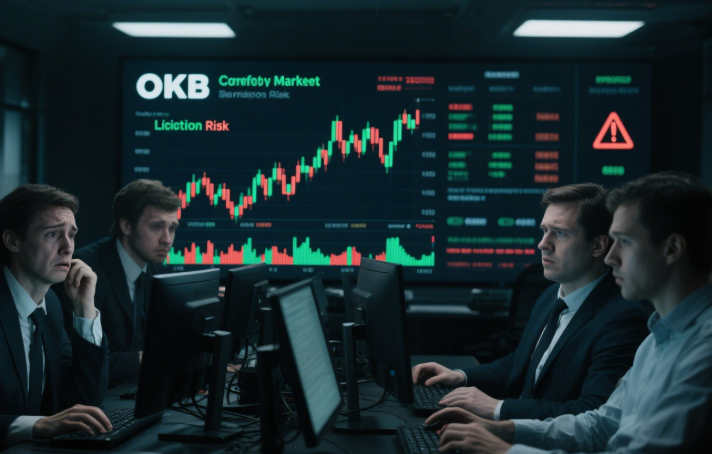
The liquidity risk in the futures market is also an important pitfall in OKB high-leverage trading. When the market fluctuates violently, the liquidity in the futures market may suddenly decline, making it impossible for investors to close their positions in time.
In some extreme cases, there may be a large number of sell or buy orders in the market, but there are not enough counterparties to take them over, which will cause the futures price to gap significantly. For example, when there is a panic selling in the market, a large number of investors place sell orders for OKB futures at the same time, but there are few buy orders in the market. This will cause the futures price to drop rapidly, and investors may not be able to close their positions at the expected price.

To reduce liquidity risk, investors should choose to operate during periods of good market liquidity when engaging in high-leverage trading. Generally speaking, the liquidity in the futures market is better during peak trading hours, such as the European and American trading sessions. In addition, investors can also diversify their investments to avoid concentrating all their funds in one futures contract, thus reducing the risk caused by insufficient liquidity of a single contract.
In conclusion, although OKB high-leverage trading is full of allure, the three hidden pitfalls cannot be ignored. For Bitcoin investment enthusiasts and novices, when participating in OKB futures market trading, they must fully understand these risks, reasonably choose the leverage ratio, set stop-profit and stop-loss points, and pay attention to reducing liquidity risk. Only in this way can they survive in the challenging cryptocurrency market and achieve their investment goals.